
Regular tic-tac-toe is simple enough that two experienced players will almost always draw. But what happens when you have nine boards instead of one?
That's Ultimate Tic-Tac-Toe. There are 81 cells, but you can't simply play wherever you want: every move you make decides which small board your opponent must play in next. That's where things get interesting.
This guide explains the rules step by step, then gives five strategies for your first games. The rules are the ones Ezee Play's version of the game uses, and the screenshots come from a real match played in it. You can play Ultimate Tic-Tac-Toe in your browser while you read.
Ultimate Tic-Tac-Toe rules in brief
- The board is nine small tic-tac-toe boards arranged in a large 3×3 grid: 81 cells in all.
- Two players, X and O, take turns. X goes first and may play any cell.
- The cell you play inside a small board sends your opponent to the matching small board on the large grid. Play a top-right cell, and they must play in the top-right board.
- Three in a row in a small board captures it. A small board that fills up with no winner is drawn. Captured and drawn boards are closed: nobody plays there again.
- If you are sent to a closed board, you get a free move: play in any open board.
- Capture three small boards in a row on the large grid, across, down or diagonally, to win.
- If every small board closes and nobody has three in a row, the match is a draw.
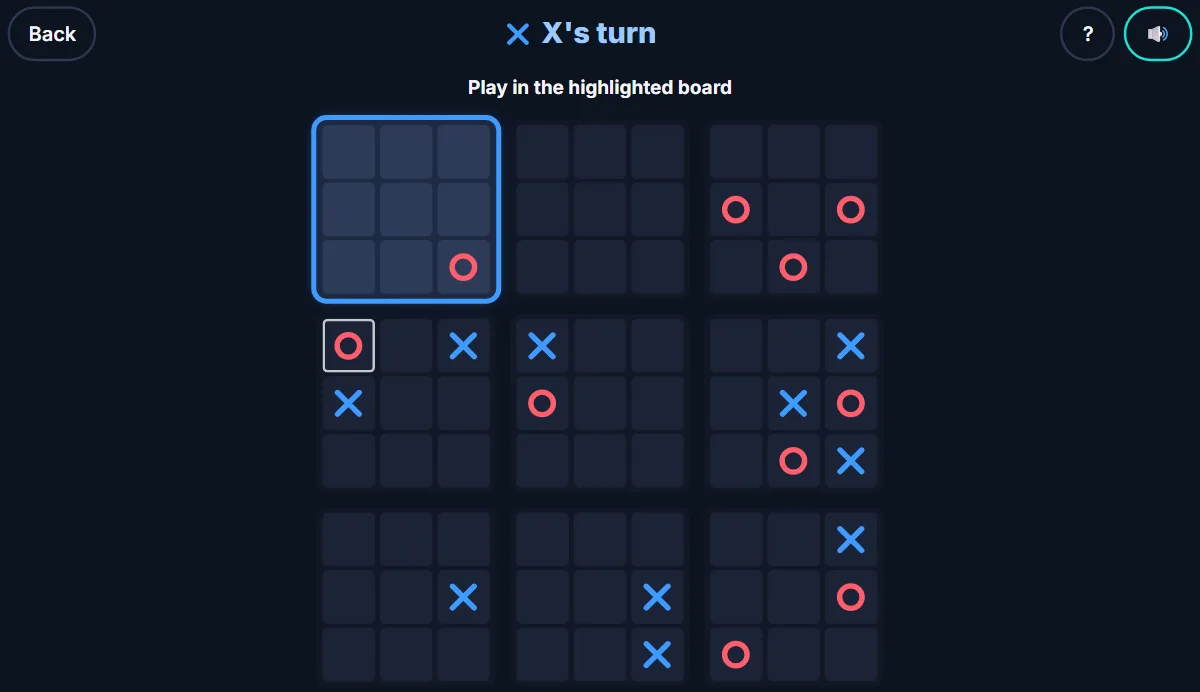
The board: 81 cells, nine boards
Picture an ordinary tic-tac-toe grid, then put a whole tic-tac-toe board in each of its nine squares. Each small board is played like normal tic-tac-toe, and the large grid is a tic-tac-toe board whose squares are those small boards.
The same nine positions name both levels: top-left, top, top-right, left, centre, right, bottom-left, bottom and bottom-right. The top-right cell of a small board and the top-right board of the large grid share a position, and that link is the heart of the game.
The key rule: your cell picks their board
Every move you make chooses your opponent's next board. The position of your cell inside its small board is the position of the board your opponent must play in on the large grid.
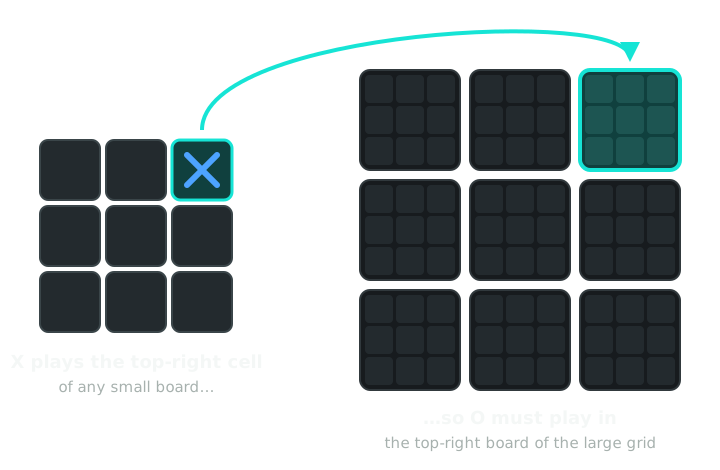
Some examples:
- Play the centre cell of any small board, and your opponent must play in the centre board.
- Play the bottom-left cell of any small board, and they must play in the bottom-left board.
- In the screenshot above, O played the top-left cell of the left board, so X has to play in the top-left board.
Only X's very first move is unrestricted. After that, each player usually has just one board to play in, and the board they are sent to is one their opponent chose for them. On Ezee Play, the game highlights that board and says "Play in the highlighted board", so you can always see where to play. The quickest way to get a feel for it is to try a match against the computer on Easy.
Capturing, drawn boards and free moves
Capturing a board. Get three of your marks in a row in a small board, across, down or diagonally, and that board is yours. It shows your mark, large, from then on.
Drawn boards. A small board that fills up without either player making three in a row is drawn. It belongs to nobody.
Closed boards. Captured and drawn boards are both closed. Nobody can play in them again, even if a captured board still has empty cells.
Free moves. If your opponent's cell sends you to a closed board, you get a free move: you may play an empty cell in any open board. The game tells you with "Free move: play in any open board" and highlights every board you can choose.
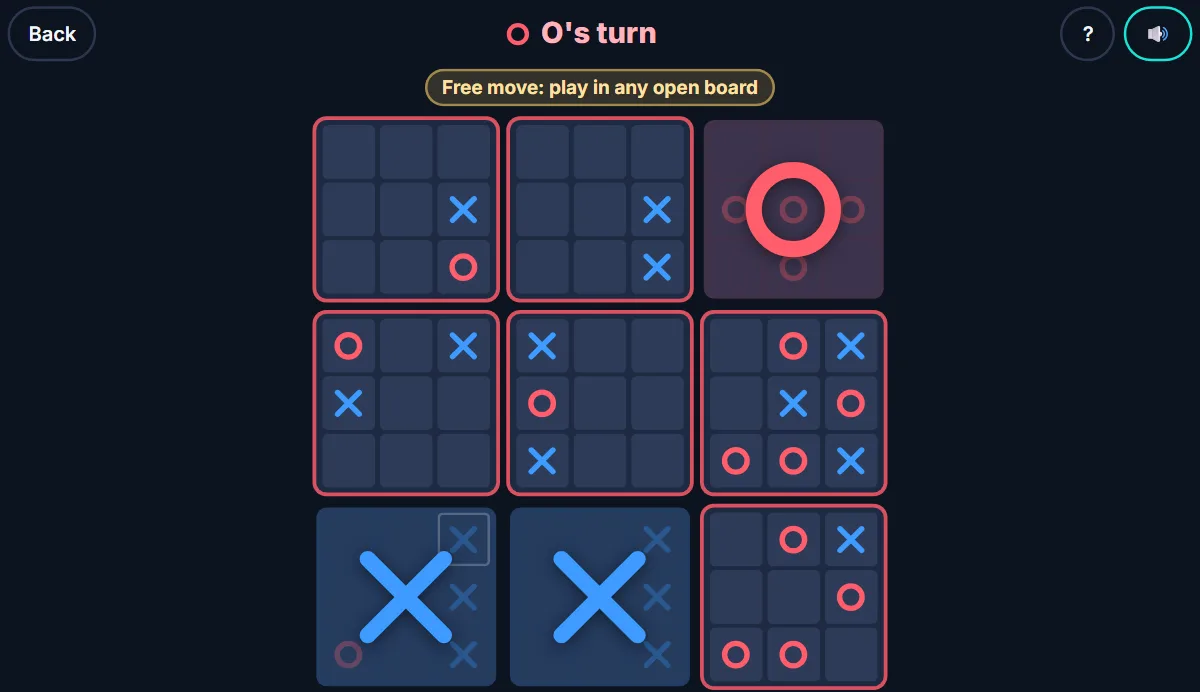
In this position, X has just played the top-right cell of the bottom-left board. That move did two things: it completed X's line in that board, capturing it, and it sent O to the top-right board. O had already captured the top-right board, so it is closed, and O may play in any of the six boards still open.
How to win, and how a match is drawn
You win by capturing three small boards in a line on the large grid: a row, a column or a diagonal. The match ends the moment that line is complete, even if other boards are still open.
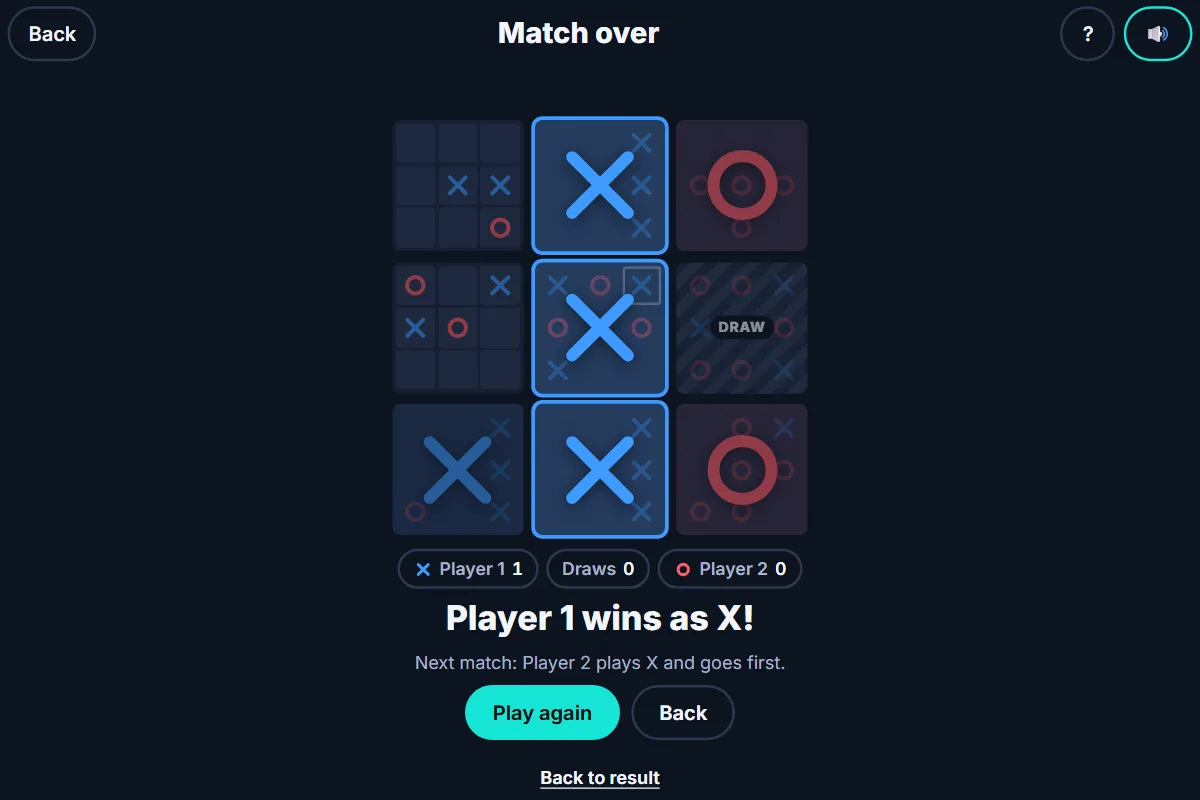
In this match, X won with the top, centre and bottom boards. O captured two boards on the right, but the right board between them was drawn, so O could never complete that column. A drawn board blocks every line through it, for both players.
If every small board is captured or drawn and nobody has a line of three, the match is a draw. On Ezee Play, the number of boards each player has captured doesn't break the tie.
Rule variations you may see
Ultimate Tic-Tac-Toe is played with a few house rules, so you may have learned it differently:
- In some versions, a won board stays open while it has empty cells, and you can be sent back into it.
- Some players break a drawn match by counting who captured more small boards.
Ezee Play uses the rules described in this guide: a captured or drawn board is closed, being sent to a closed board gives a free move, and a match with no line of three is a draw. The Wikipedia article on Ultimate tic-tac-toe covers the history and other variants.
Five beginner strategies
1. Every move is two moves
Each move does something on its own small board and chooses your opponent's next board. Before you play a cell, look at the board it sends them to. If they could capture that board, or set up a big-board line there, look for another cell if you have one.
For example, say you are X in the top-left board, and its bottom-right cell would give you two in a row there. It looks like a good move. But a bottom-right cell sends O to the bottom-right board, and if O already has two in a row in that board with the third cell empty, O captures it straight away. A quieter cell that sends O somewhere harmless is often the better move.
2. Think twice before giving a free move
A free move lets your opponent play in any open board, so they get to choose the board that suits them best. That freedom is usually worth a lot, especially early in a match when many boards are open. It isn't always a disaster, though: when only a few boards are open and none of them gives your opponent a capture or a threat, a free move may help them very little.
As a beginner, treat it as a warning sign. Once a board closes, the cell in that same position on every other board gives a free move to whoever you send there. Before you play one of those cells, check the open boards for anything your opponent could capture.
3. Think in big-board lines
A captured board helps you most when it can be part of a line of three on the large grid. Capturing a board that no longer fits any line you could still make gains you less, although it still blocks your opponent's lines through that board. A drawn board blocks lines for both players, so drawing a board on purpose can stop an opponent's line.
4. Use the centre board carefully
On the large grid, the centre board is part of four possible winning lines: the middle row, the middle column and both diagonals. Each corner board is part of three, and each edge board is part of two. That makes the centre board important in many matches, but its real value depends on the position. If the lines through it are already blocked, a corner or edge board that completes your line matters more.
Remember too that every centre cell you play sends your opponent to the centre board. Beginners who play centre cells out of habit give their opponent turn after turn there. Play a centre cell when you want them in the centre board, not by default.
5. Send them where they can't hurt you
The best board to send your opponent to is one where they can't capture anything soon, or where every cell they might play sends you back to a board you want. A board that is nearly settled, or one where you already block their lines, is often a safe place to send them.
To see these ideas work, try them one at a time against the computer on Medium.
Common beginner mistakes
- Looking only at the board you are playing in, and forgetting where your cell sends your opponent.
- Giving your opponent a free move without checking what they could do with it.
- Capturing boards that don't line up with anything on the large grid.
- Playing centre cells by habit, giving away the centre board.
- Forgetting that a drawn board blocks lines for both players.
Ways to play Ultimate Tic-Tac-Toe
Ultimate Tic-Tac-Toe on Ezee Play runs in your browser, on a phone or a computer, with nothing to install and no account. It has three ways to play:
- Play the computer. Choose Easy, Medium or Hard, and whether you play X and go first, or O and let the computer start. Easy takes a match win or captures a board whenever it sees one, so it punishes careless moves, but otherwise it doesn't plan ahead. Medium looks a few moves ahead, and Hard searches far more possible continuations. The game keeps your wins, losses and draws at each level.
- Two players here. Take turns on one device. The marks swap after each match, so the other player goes first next time.
- Play online. Create a game and send a friend the link. Each player has 60 seconds per move.
"How to play" is on the start screen and during a match if you need a reminder. On a computer, the arrow keys move across all 81 cells and Space or Enter plays.
Frequently asked questions
What happens if I'm sent to a full board?
A board that has been captured or drawn is closed, so you get a free move: play an empty cell in any open board.
Can you play in a board that has already been won?
Not on Ezee Play. A captured board is closed even if it still has empty cells. Some house rules keep it open, so agree on the rules before playing on paper.
Who goes first in Ultimate Tic-Tac-Toe?
X always goes first, and the first move can be any cell on any board.
Can Ultimate Tic-Tac-Toe end in a draw?
Yes. If every small board is captured or drawn and nobody has three boards in a row, the match is a draw.
Ready to play?
Or find more free games on Ezee Play.